
Introduction :
Have you ever wondered how your washing machine knows when to stop, or how your car’s airbag opens at the right time?
Behind these smart actions is something very powerful — an Embedded System.
Let’s begin your journey into the world of Embedded Systems Basics.
What is an Embedded System?
An Embedded System is a small computer built inside a device to do one special job.
It doesn’t do many things like your laptop — instead, it does one task, but it does it very well.
Simple Examples:
- Microwave oven – controls cooking time.
- Washing machine – runs different cycles.
- Fitness watch – counts your steps.
- Car airbag – opens instantly in an accident.
- Printer – prints when you press the button.
Each of these has a small brain inside — that’s the embedded system.
How Does It Work?
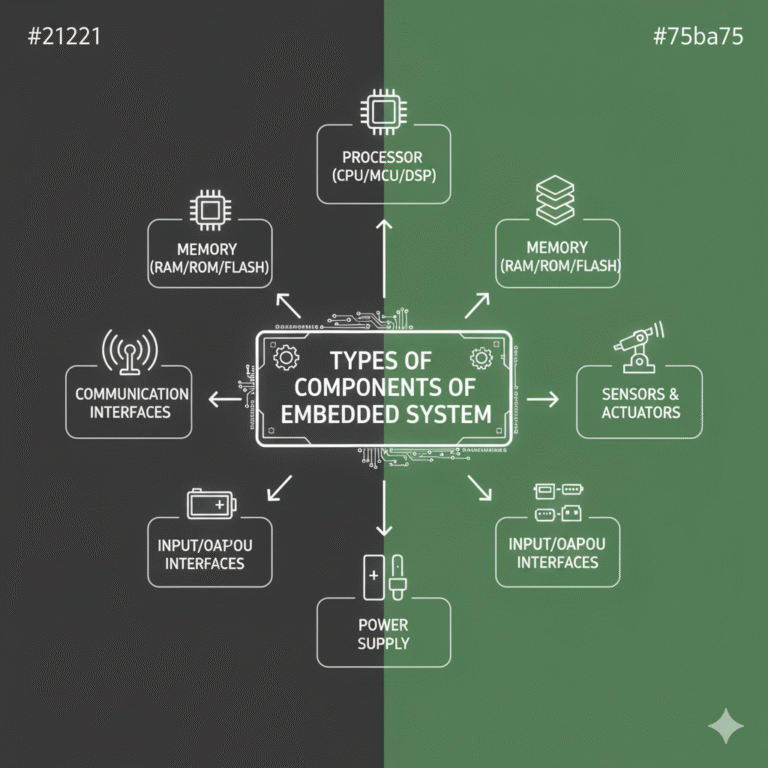
Every embedded system has three main parts:
- Hardware (The Body)
Made of electronic parts like microcontrollers and sensors. It collects data and sends signals. - Software (The Brain)
Written in C or C++, this is the program that tells the hardware what to do. - Input and Output (The Eyes and Hands)
Inputs read data (like light or temperature).
Outputs take action (like turning a fan ON or showing numbers on a screen).
Example: Automatic Room Light
Let’s say you want a light that turns on when it’s dark.
- The sensor checks how bright the room is.
- The microcontroller reads that information.
- If it’s dark → “Turn the light ON.”
- If it’s bright → “Turn the light OFF.”
That’s how simple and smart an embedded system can be!
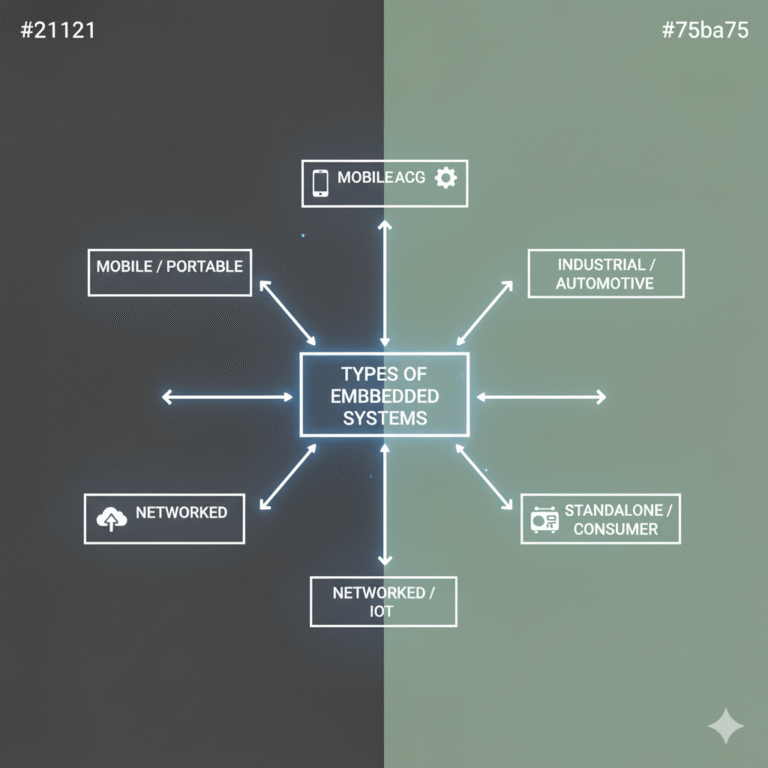
Types of Embedded Systems
Based on what they do, we can group them like this:
- Small Scale: Calculators, digital watches.
- Medium Scale: Washing machines, alarms.
- Complex Scale: Robots, drones, medical equipment.
Or based on time response:
- Real-Time Systems: Work instantly (like airbags).
- Non-Real-Time: Take time (like a washing machine).
Microcontrollers – The Heart of It All
Every embedded system has a microcontroller — a tiny chip that acts like a mini-computer.
A microcontroller has:
- A small processor to make decisions.
- Memory to store the program.
- Ports to connect sensors or motors.
Some popular microcontrollers:
- 8051
- Arduino
- PIC
- ARM Cortex-M
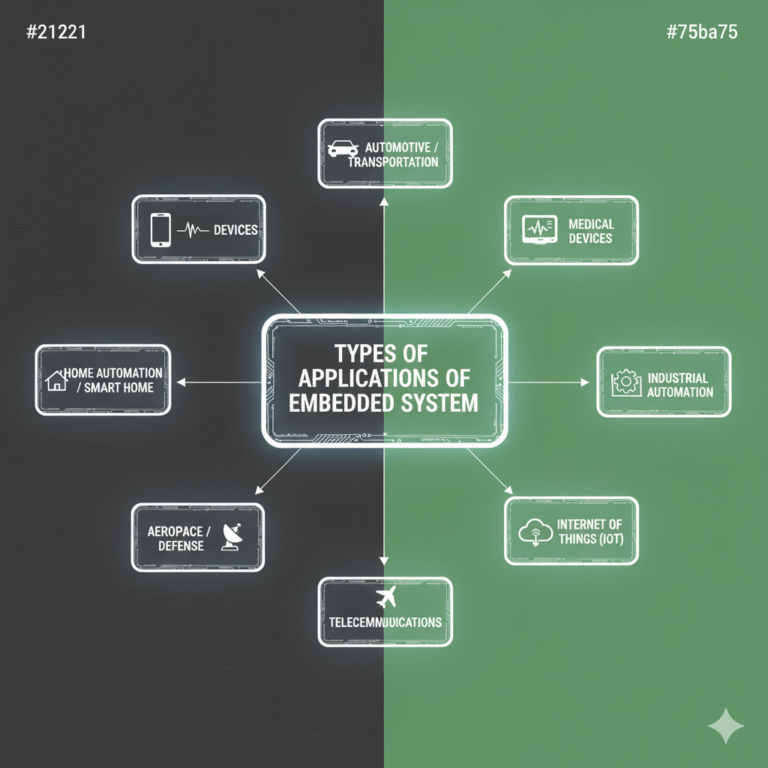
Where Are Embedded Systems Used?
Embedded systems are part of our everyday life:
- Home Appliances: Smart TVs, ovens, washing machines.
- Automobiles: Airbags, brakes, engine control.
- Medical Devices: Heart monitors, digital thermometers.
- Industry: Robots, factory automation, sensors.
- Communication: Routers, smartphones, satellites.
Everywhere you look, there’s an embedded system doing something smart.
Why Are Embedded Systems Important?
They make our lives:
- Easier – Automatic systems save time.
- Safer – Airbags and alarms protect lives.
- Efficient – Save power and resources.
- Smarter – Devices learn to think and act faster.
Without them, modern life would be slow and manual.
How to Start Learning Embedded Systems
At Vintech Embedded Academy, we help beginners grow step-by-step:
- Learn Electronics: Understand sensors, resistors, LEDs.
- Learn Programming: Start with Embedded C.
- Try Boards: Work on Arduino or ARM Cortex-M.
- Do Projects: Make small systems like blinking LEDs or sensors.
- Build Advanced Systems: Create smart home or robotic projects.
The best way to learn is by doing — building your own smart systems!
The Future of Embedded Systems
The future is all about IoT (Internet of Things) — where devices talk to each other using the internet.
Examples:
- A fridge that sends you a grocery list.
- A smartwatch that sends health data to your phone.
- Smart traffic lights that reduce jams.
Embedded systems are leading this change — and those who learn today will shape tomorrow.
Conclusion
Embedded systems are the silent heroes behind every smart device.
They make machines think, respond, and help us every single day.
Learning embedded systems is the key to creating the next generation of smart technology.
If you’re curious about how things work and want to build your own devices — this is where your journey begins.
Start learning today, and become the mind behind tomorrow’s machines.
-Vintech Academy Blog Post