


Introduction :
Have you ever pressed a button on your TV remote and wondered what happens inside? Or seen an automatic door open when you walk near it?
Behind these smart actions lies a tiny brain called an Embedded System.
It may look small, but it can think, decide, and act — all in just a fraction of a second.
In this blog, let’s explore how an embedded system works, step by step, in a way that’s easy to understand.
Embedded System Overview
An embedded system is a small computer built inside a machine to control its functions automatically.
It is a mix of hardware (the body) and software (the mind) that work together to do one special job.
For example:
- In a washing machine, it controls water level and timing.
- In a car, it controls airbags and engine speed.
- In a microwave, it controls heat and cooking time.
Now let’s see how all this magic actually happens inside.
The Working Process of an Embedded System
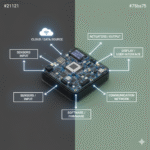
Every embedded system works in a loop of three main steps:
- Input – It collects data from sensors or buttons.
- Processing – It makes a decision based on that data.
- Output – It performs an action or gives a result.
Let’s look at each step in detail.
Step 1: Input — The System Collects Information
An embedded system starts by receiving input from the real world.
This input can come from different sources:
- Sensors (measure temperature, light, sound, or motion)
- Buttons or switches (pressed by users)
- Communication signals (from other devices)
Example:
In an air conditioner, a temperature sensor checks how hot the room is.
That reading becomes the input for the system.
So, the first job of an embedded system is to sense what’s happening around it.
Step 2: Processing — The Brain Makes a Decision
After receiving input, the system’s microcontroller or microprocessor starts to process it.
The microcontroller reads the input and follows the instructions written in its program (called firmware).
For example:
- If the temperature > 25°C → Turn ON the cooling.
- If the temperature < 20°C → Turn OFF the cooling.
This logic is written using programming languages like Embedded C.
Example:
In a washing machine, when the “Start” button is pressed, the microcontroller checks water level, then starts the motor — following the instructions written in its program.
So, the second job of an embedded system is to decide what action to take.
Step 3: Output — The System Takes Action
Once the system makes a decision, it sends a signal to output devices to do their job.
Output devices can be:
- Motors – to move parts
- LEDs or displays – to show status
- Buzzers or speakers – to make sounds
- Relays or switches – to control power
Example:
In a microwave oven, once the timer ends, the system turns OFF the heating coil and makes a beep sound.
So, the third job of an embedded system is to perform the correct action automatically.
The Cycle Keeps Repeating
The process of Input → Processing → Output keeps repeating continuously.
The system works in a loop, checking inputs again and again to respond to any new changes.
For example:
In an automatic streetlight, the light sensor keeps checking brightness. When it gets dark → the light turns ON. When it’s bright again → the light turns OFF.
All of this happens automatically, without any human help!
The Key Components That Make It Work
Let’s look at the important parts that make this process possible:
1. Microcontroller – The Brain
It’s a small chip that does all the calculations and controls the system.
Examples: Arduino, STM32, PIC, or ARM Cortex.
2. Memory – The Storage
It stores the program (firmware) and temporary data while running.
3. Sensors – The Eyes and Ears
They help the system sense changes like heat, light, or movement.
4. Actuators – The Hands and Legs
They do actions — like turning on motors or moving robotic arms.
5. Power Supply – The Energy Source
Without power, the system can’t work. Batteries or adapters supply the energy.
Each part plays a special role, and together, they make the system function smoothly.
A Simple Example: How a Smart Fan Works
Let’s take a real example — a smart fan that turns ON automatically when it’s hot.
Here’s what happens step by step:
- Input: The temperature sensor reads the room temperature.
- Processing:
- If temperature > 30°C → Turn ON fan.
- If temperature < 28°C → Turn OFF fan.
- Output:
- The fan motor starts or stops accordingly.
All this happens in just a second!
The fan doesn’t think like humans, but it follows programmed logic — that’s what makes it “smart.”
Real-Time Operation
One of the most important things about embedded systems is that they work in real time.
That means they respond immediately to changes.
For example:
- Car airbags open instantly during an accident.
- Traffic lights change on time to manage flow.
- Robots stop instantly when they sense an obstacle.
If these systems were slow, they could cause errors or even accidents. That’s why speed and timing are very important in embedded systems.
The Role of Firmware
Firmware is the permanent program written inside the microcontroller’s memory.
It tells the hardware exactly what to do.
- It starts running when power is turned on.
- It controls how input, processing, and output happen.
- It stays stored even when power is off.
Without firmware, an embedded system can’t do anything — it’s like a body without a brain.
Communication Between Components
Many embedded systems talk to other devices using communication protocols like:
- UART (for serial communication)
- SPI (for fast data transfer)
- I2C (for connecting multiple sensors)
These help the parts inside the system share data quickly and accurately.
Example:
A smart home system may connect sensors, lights, and fans together — all communicating through these protocols.
Power and Efficiency
Embedded systems are designed to use very little power.
They sleep when not in use and wake up only when needed.
This helps them run for years — especially in battery-powered devices like remotes, smartwatches, or sensors.
Applications of Embedded Systems
Understanding how they work helps us appreciate where they’re used:
- Home Automation: Lights, fans, and security systems.
- Automotive: Airbags, ABS, and speed control.
- Medical Devices: Heart monitors, insulin pumps.
- Industrial Control: Robots, packaging systems.
- Consumer Electronics: Smart TVs, washing machines.
Every modern technology you use runs on embedded systems!
The Future of Embedded System Working
In the future, embedded systems will become:
- Smarter with Artificial Intelligence (AI)
- Connected through the Internet of Things (IoT)
- Smaller and faster with new microchips
- More reliable with better sensors and software
This means your home, car, and even your city will become more intelligent and connected.
Conclusion
An embedded system works like a tiny brain inside machines — it senses, decides, and acts automatically.
It follows a simple loop: Input → Processing → Output, running again and again in real time.
From turning on lights to flying rockets, this small technology runs the modern world silently and smartly.
So next time your washing machine starts or your car alarm beeps — remember, an embedded system is doing all the work for you!
-Vintech Academy Blog Post